
Why Are Thermal Cameras So Expensive? (Know Reasons 2025)
Thermal cameras cost more because they use advanced infrared sensors, a strong lens, and fast image processing. These parts need careful design and high quality. You pay for clear heat readings that help you make accurate decisions.
We will explore why thermal cameras cost much more than regular cameras while providing unmatched thermal detection and accuracy.
How Are Thermal Cameras Different from Normal Cameras?
Thermal cameras detect heat instead of visible light. This allows them to see in darkness, smoke, or fog, which normal cameras cannot do. Normal cameras are for photos or videos, but thermal cameras are for inspections, security, and monitoring.
Why Are Infrared Sensors Important in Thermal Cameras?
Infrared sensors are the heart of a thermal camera. They detect heat from objects and convert it into a thermal image, which is crucial for accuracy and reliability in professional use.
- High Sensitivity: Can detect very small temperature differences, sometimes as low as 0.05°C.
- Accuracy Matters: Better sensors provide precise thermal readings for professional work.
- Durability: High-quality sensors last longer and maintain performance in extreme conditions.
- Types of Sensors: There are cooled and uncooled sensors, with cooled ones being more expensive but highly accurate.
- Impact on Price: Sensor quality is one of the biggest factors that make thermal cameras costly.
How Do Lenses Affect Thermal Camera Performance?
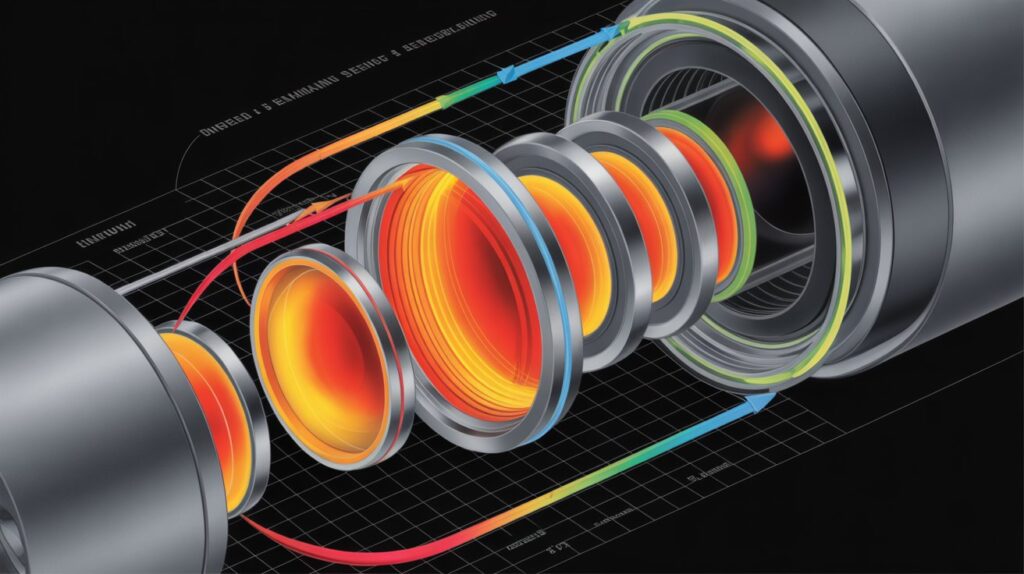
Lenses play a major role in how well a thermal camera works. A good thermal lens controls how much infrared energy reaches the sensor, which directly affects image clarity, accuracy, and detail. If the lens quality is low, even a high-end sensor will not perform well.
Thermal cameras use special lenses made from infrared-friendly materials, not normal glass. These lenses decide the field of view, focus sharpness, and how clearly temperature differences appear. A well-designed lens helps the camera detect small heat changes, measure temperature more accurately, and produce cleaner images in real-world conditions. In short, better lenses mean better performance, reliability, and trust in thermal results.
Why Is Image Processing Important in Thermal Cameras?
Image processing is important in thermal cameras because raw thermal data alone is not clear or useful for users. Thermal sensors only capture heat values, but image processing converts this data into clear, readable, and meaningful images.
Makes Thermal Images Clear and Sharp:
Without image processing, thermal images look blurry and noisy. Image processing improves:
- Sharpness
- Contrast
- Image clarity
This helps users easily identify objects, people, or heat sources.
Improves Temperature Accuracy:
Image processing corrects errors caused by:
- Distance
- Environment
- Reflections
This ensures more accurate temperature readings, which are critical in industrial, medical, and safety applications.
Helps Detect Problems Early:
Thermal cameras are often used to detect:
- Electrical faults
- Overheating machines
- Heat leaks
Image processing highlights abnormal heat patterns, making problem areas easy to spot.
Converts Data into Easy-to-Understand Colors:
Raw thermal data is converted into colour palettes (like red, yellow, and blue). This allows users to:
- Quickly understand temperature differences
- Analyze heat distribution visually
Enhances Performance in Low-Light or No-Light Conditions:
Thermal cameras work in darkness, smoke, or fog, but image processing ensures the image remains clear and usable in all conditions.
What Manufacturing Challenges Increase Thermal Camera Costs?
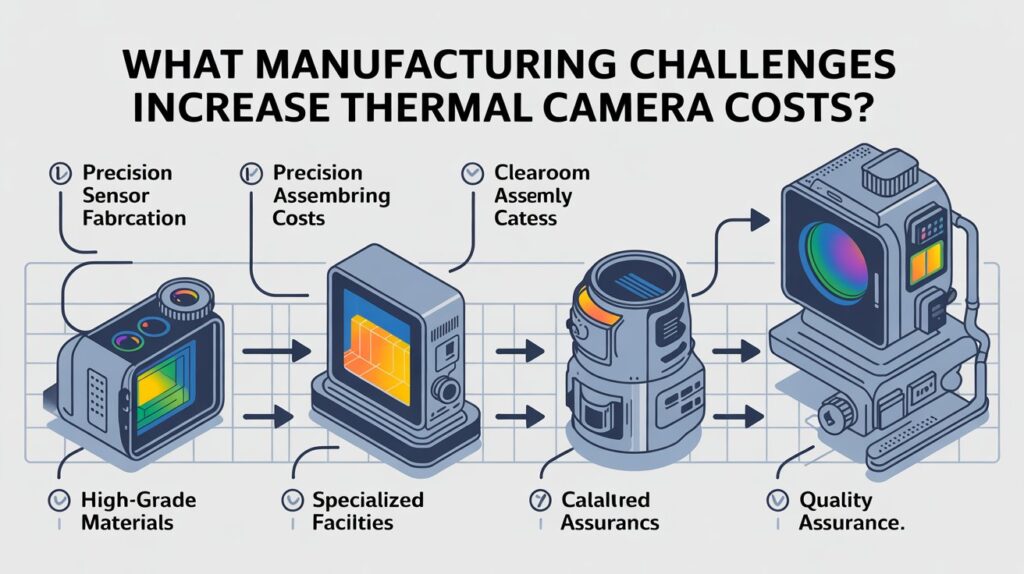
Thermal cameras cost more because they are difficult to manufacture and require extreme precision. Unlike normal cameras, even a small mistake in production can increase cost or waste the component.
| Manufacturing Challenge | How It Increases Cost |
| Infrared sensor materials | High raw material cost |
| Low sensor yield | More waste, fewer usable units |
| Individual calibration | Skilled labor and time |
| Clean-room manufacturing | Expensive facilities |
| Advanced processing hardware | Costly components |
| Strict quality testing | Extra labor and equipment |
| Limited production scale | No mass-production savings |
How Does Research and Development (R&D) Affect Thermal Camera Prices?
Research and Development (R&D) increases thermal camera prices because companies invest heavily in improving accuracy, reliability, and performance. This long-term investment is added to the final product cost.
How R&D Increases Cost:
- Sensor Innovation: Engineers work to improve sensitivity and temperature accuracy.
- Software Development: Teams build and test image processing algorithms.
- Prototype Testing: Multiple versions are tested and refined before final production.
- Performance Validation: Cameras are tested in real-world conditions to ensure accuracy.
Which Materials Make Thermal Cameras Durable?
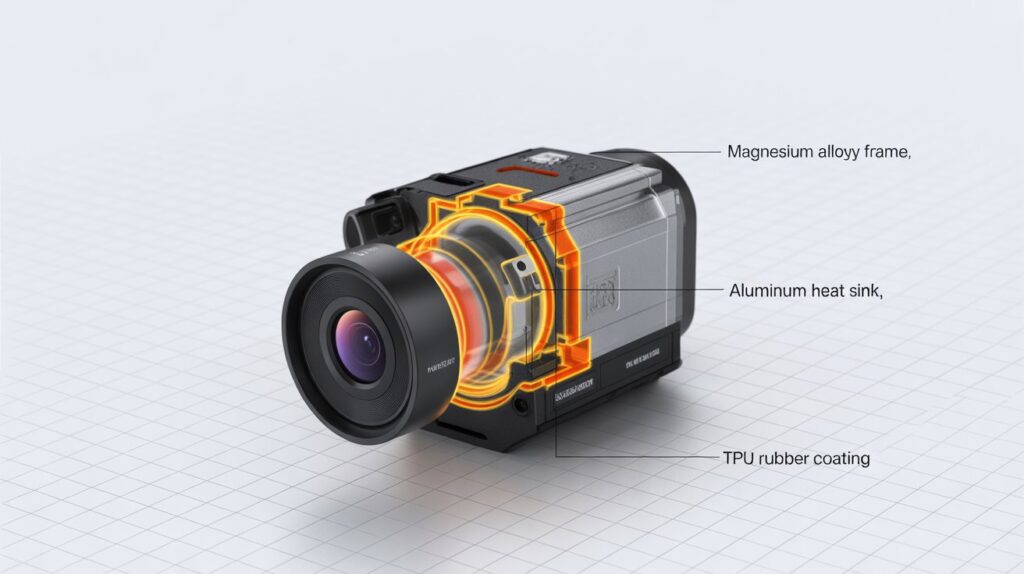
Thermal cameras are built for tough environments, so durability depends heavily on the materials used. Manufacturers choose strong, heat-resistant, and weather-proof materials to protect sensitive internal components.
| Material Used | Durability Benefit |
| Magnesium alloy | Strong and impact-resistant |
| Aluminum | Lightweight structural support |
| Germanium lens | Scratch-resistant and IR-friendly |
| Rubber coating | Shock absorption |
| Sealed components | Protection from dust and moisture |
Why Do Limited Production Volumes Raise Prices?
Thermal cameras are not mass-market products like smartphones. They are made in smaller quantities for specific professional users, which keeps prices high.
Why Low Volume Increases Cost:
- No Mass Production Savings: Fewer units mean a higher cost per camera.
- Specialized Manufacturing: Factories are set up for precision, not speed.
- Higher Component Costs: Parts are bought in small batches at higher prices.
- Niche Market: Demand primarily comes from professionals, rather than everyday users.
What Applications Justify the Cost of Thermal Cameras?
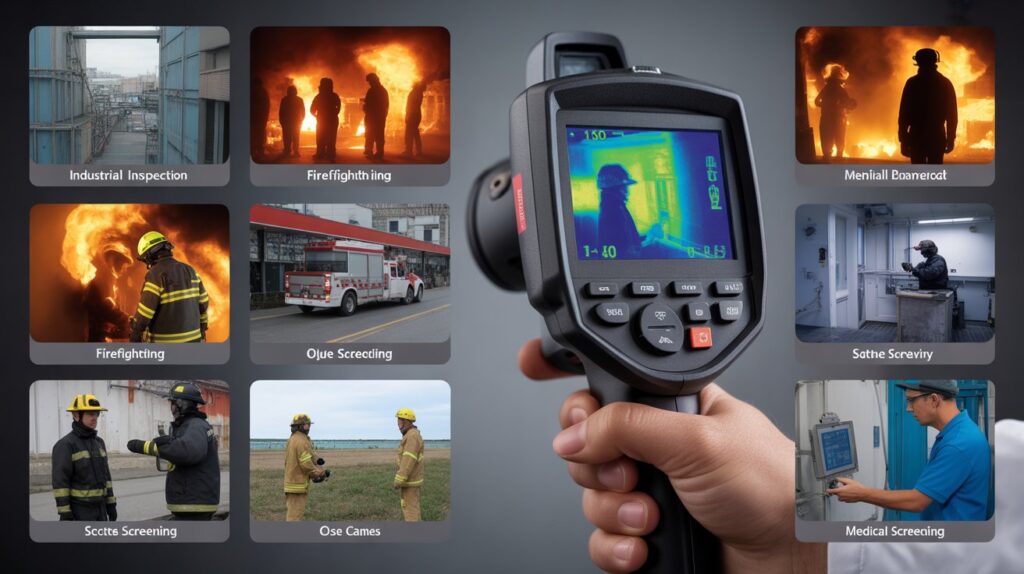
Thermal cameras are expensive, but in many fields they save time, prevent damage, and protect lives. In these cases, the value they provide is much higher than their cost.
Industrial Maintenance and Inspection:
Thermal cameras help detect overheating machines and electrical faults early.
This prevents costly breakdowns and unplanned shutdowns.
Electrical and Power System Monitoring:
They identify hot spots in cables, panels, and transformers.
Early detection reduces fire risk and repair costs.
Building and Energy Audits:
Thermal cameras find heat leaks, poor insulation, and air gaps.
This helps reduce energy loss and lowers long-term utility bills.
Firefighting and Emergency Services:
Firefighters use thermal cameras to see through smoke and darkness.
They help locate people faster and improve rescue safety.
Security and Surveillance:
Thermal cameras detect intruders in total darkness or fog.
They work reliably where normal cameras fail.
Medical and Healthcare Screening:
Thermal imaging supports non-contact temperature checks.
It is useful for fast screening without physical contact.
How to Choose the Right Thermal Camera for You?
Choosing the right thermal camera depends on your actual use, not the most expensive model. When features match your needs, you get better results and real value for money.
| Feature | Why It Matters |
| Application type | Determines required features |
| Thermal resolution | Controls image detail |
| Temperature range | Ensures safe measurements |
| Image processing | Improves clarity |
| Accuracy | Affects decision quality |
| Build quality | Increases durability |
| Price vs features | Ensures value for money |
FAQ’s:
Are thermal cameras expensive only because of the brand?
No. The main cost comes from technology, accuracy, and manufacturing complexity.
Do thermal cameras need expensive sensors?
Yes, they use infrared sensors made from advanced materials that detect heat instead of visible light.
Are cheap thermal cameras less accurate?
Yes, Lower-cost models often have reduced resolution, accuracy, and a limited temperature range.
Are thermal cameras expensive because of low production volume?
Yes, they are produced in smaller quantities, which increases per-unit manufacturing cost.
Are thermal cameras worth the high price?
Yes, for safety, industrial, and professional use, they prevent failures, save time, and reduce risks.
Conclusion:
Thermal cameras are expensive because they use advanced infrared sensors, special lenses, precise manufacturing, and years of research. When you understand why thermal cameras are so expensive, the price makes sense, especially for safety, inspections, and professional use where accuracy and reliability truly matter.